The Capital Ring Walk consists of fifteen segments that completely encircle London. The total distance is about 125 km, with each segment consisting of from 7 or 8 km to 15 km or so, easily manageable in two or three hours. The start and finish of the segments coincide with Underground or rail stations. Maps and guides for each segment are available here.

We will organise this as a group, walking every two or three Sundays, weather permitting, with an 11 AM start, and either conclude with a lunch somewhere at the end of the walk, or stop along the way. Perhaps in the warmer months we can plan on a picnic.

We will not walk in the rain, or if there is a strong likelihood of rain or similar foul weather.

Participants are encouraged to make comments and post photographs. If a walk is to be postponed because of bad weather, this will be announced on the blog a few hours before the start.

08 April 2012

Stoke Newington to Hackney Wick


On an overcast and somewhat damp day, we did our third walk of the Capital Ring, section 13, which goes from Stoke Newington to Hackney Wick. Again, there were four of us: Penelope, Nadia, myself and Michael Kearney who has joined us and who we hope will be back for future walks.
Micheal, Nadia and Penelope at the entrance to Springfield Park.
We began at Stoke Newington train station, walking through a very attractive residential neighbourhood until we reached Springfield Park. It is a very charming park, looking down on the Walthamstow marshes and the River Lea.
Springfield Park is a nature site that has been designated London’s first Regionally Important Geological Site – RIGS – and is on the English Register of Parks and Gardens of Historic Interest. It takes its name from springs that arise in the area. At the bottom of the park is a pedestrian bridge that crosses the River Lea. To the left is the Springfield Marina, full of the narrowboats that navigate the canals.
Catlovers spot a moggy on the roof of a canal boat.
Basically, today’s walk followed the River Lea. The River Lea was the historic boundary between Essex and Middlesex. Most of the time we walked on the old towpath, which is nicely refurbished making for easy walking and cycling.. I think one could live in London for many years and never even know that this beautiful river environment exists. You need to walk or cycle to see it.
No kite flying!
To the left of the path is the Walthamstow Marsh, a huge expanse of land that is part of the larger Hackney Marshes. In the past, it was a summer meadow known as Lammas Land, left to grow and then cut for hay later in the year. Now it hosts a nature reserve.
It was here that the first flight in Britain took place, and there are some small monuments to mark this. In 1909, a bit more than a century ago, A.V. Roe flew his ‘Yellow Terror’ tri-plane for 900 feet across one of the marshes. It was build under the arches of a bridge we walked past.
Springfield Marina.
The Marshes, and site of first flight in England.
Canal boat and pub.
Leabank Square. Check their website.
Colourful new buildings on the riverside.
Passing under a bridge where a weir separates the River Lea from the Lea Navigation Canal, we found a group of people posing for a picture. We guessed that it was a band and, sure enough, they are indeed: We Used to Make Things. Here is their website.
We Used to Make Things.
The Hackney Marshes are also home to an expanse of football pitches, apparently the biggest such collection in the world (and duly listed in the Guinness Book of World Records). There are apparently 80 pitches, and the land is known as the home of English “Sunday Soccer”. But today nobody was playing: perhaps all the matches were called off because of Easter Sunday.
The towpath continues past the Middlesex Filter Beds, which were build in 1852 to remove impurities from the River Lea. They went out of use in 1969.
Protesters camping near the Olympic site.
As we walked along, we began to pick up signs of the Olympics, including a protest camp that has been set up and signs of the efforts of government lawyers to fight off the protesters with injunctions. The Olympic site itself is surrounded by a rather daunting fence, with lots of warning wires and cameras. The only thing missing are machine gun towers and patrolling Alsatians.
Big time security at the Olympic site.
The stadium.
The Hackney Pearl.
We finished at Hackney Wick, and had a drink at the Hackney Pearl, which was the only restaurant we could find in the area. They are gearing up for a huge rush of business when the Olympics take place later this year. We had to wait more than 20 minutes for a bowl of soup. If they want to make money this summer, they’ll have to work on the service.

18 March 2012

Highgate to Stoke Newington

Penelope, Susan and Nadia
We held the second in our series of walks today. The weather wasn't as warm as three weeks ago, but at least it didn't rain. We are still only four (Penelope Soteriou, Nadia Bernaz, Susan Scott-Hunt and myself). A few who promised to join us didn't make it, possibly because of the delayed effects of St. Patrick's Day celebrations last night. Highgate underground station was the starting point. Highgate is famous for its cemetery, where Karl Marx is buried, and for other reasons too. 
From the Highgate tube, the route goes almost immediately to the Parkland Walk. It is actually the right of way of a former railway line, that operated from 1867 to 1970, that went from Finsbury Park to Alexandra Palace and Edgware. Now it is a nature reserve, and there are even some deer although we didn't see any today.
At one point, the Parkland Walk passes through an abandoned station. All that remains are the platforms. There are other signs of railway activity, including various bridges and arches. There has been a lot of decorating by graffiti artists. The route was filled with other walkers, people strolling with their dogs, and many joggers.
Former Crouch End rail station.

Graffiti-covered arches and a spriggan.

Viaduct over the main London to Scotland rail line.
The Parkland Walk continues for perhaps 3 km. At the end, it passes over the main London to Scotland railway line. Then the route enters Finsbury Park. There are some lovely spots in the park, and a café with seats reserved for dog owners!
Café in Finsbury Park with a "Seating area for dog owners".
 The route leaves the Park and then runs along the New River. The path is not paved and it was quite muddy in places. On the right is the Woodberry Down Estate, which is the largest council housing estate in all of Britain. On the left, are industrial sites. Eventually, the path comes to the end of the New River and to two reservoirs. In one of them, there were sailboats and kayaks.
Along the New River.

Swan building a nest on New River.

The Castle was formerly the pumping station.
 After leaving the reservoirs, the route crosses Clissold Park and then reaches Church Street in Stoke Newington. We'd been walking for a couple of hours without a real break, and quickly found a place to have lunch. We stopped in the Fox Reformed, which sits on the site of a former school where Edgar Allan Poe was a student for three years when his father was working in England. The food was delicious: pies made with sweet potato and goat cheese, and beef and stilton cheese. We lingered over wine and desert before deciding to make our way home.
But the high street beckoned. It has some lovely shops, including Homage, where some members of the group indulged in a bit of retail therapy. The Daniel Defoe pub acknowledges one of Stoke Newington's famous residents.
It was a great walk, refreshing and informative. A great way to spend a Sunday afternoon. Please join us on 8 April for the third segment. We start at Stoke Newington, at the rail station, and end at Hackney Wick.
Old churchyard and burial ground in Stoke Newington.

The Fox Reformed.

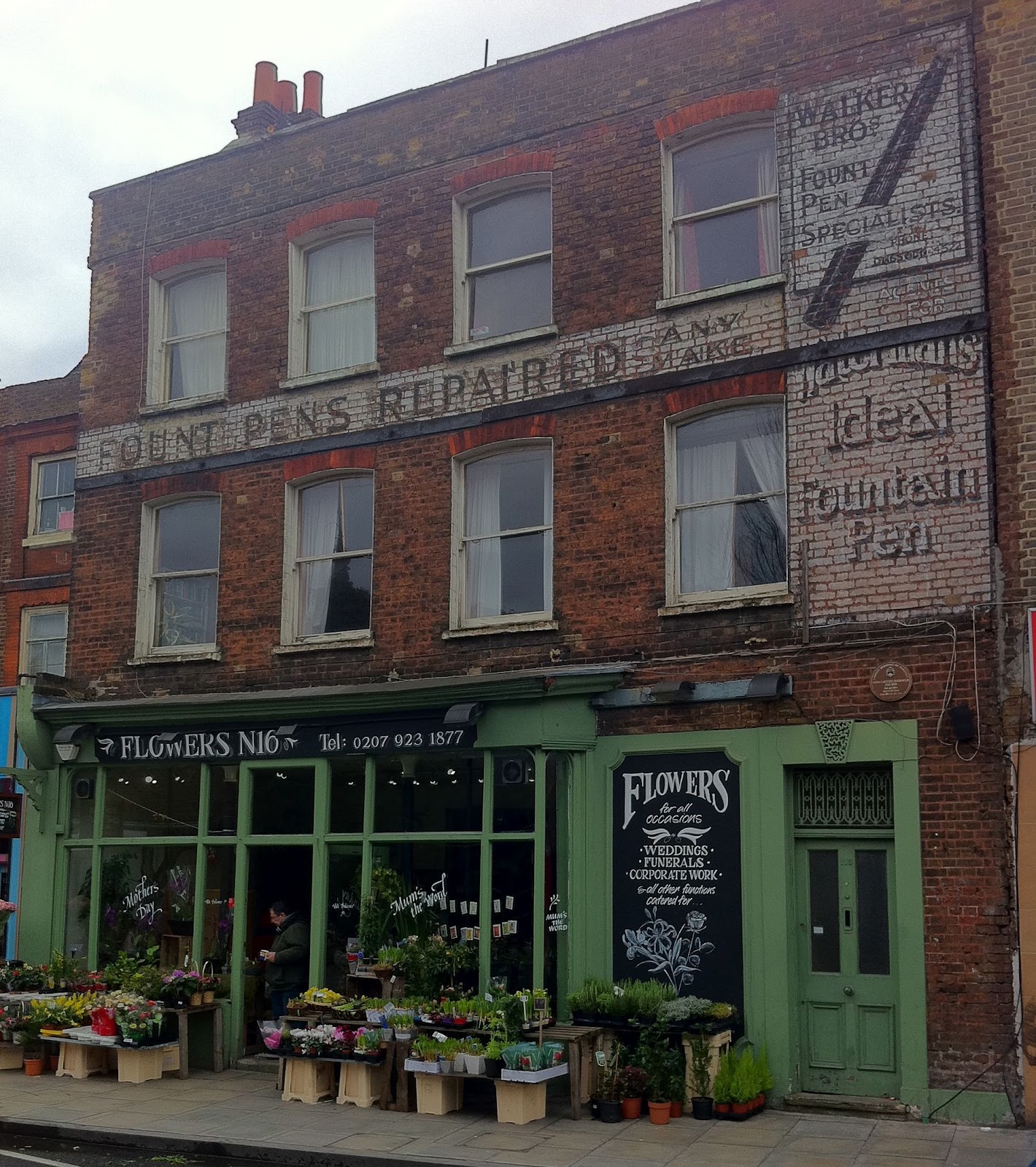
Formerly a fountain pen repair shop.

Shops in Stoke Newington.

27 February 2012

More photos of the first walk


These photos were taken by Sandra Schulberg on yesterday’s walk.

18 February 2012

The first walk: 26 February from Hendon Central to Highgate


We did the first walk, from Hendon Central underground station to Highgate, on a gorgeous February day. It was about 11 or 12 degrees with the sun shining. A great beginning. The group consisted of Penelope Soteriou, Nadia Bernaz, Sandra Schulberg (who is visiting from New York City) and myself.
From Hendon Central we walked to Hendon Park, to the path itself. This is where we will finish, 15 Sunday afternoons from now.
Sandra, Penelope and Nadia under the waymark where we met the path, in Hendon Park
While in Hendon Park, we met a man who was setting up an elaborate amateur radio antenna. He is an inventor, trying to develop a better, lightweight antenna.
Our inventor friend, explaining how his antenna works.
Sign at the exit from Hendon Park.
We left the Park and headed towards the North Circular Road. There is a short stretch on the footpath beside the busy road (said to be the noisiest road in the UK), and then we left the road into Brent Park. The path follows the River Brent, and then a succession of other little brooks and rivers until it reaches the northern part of the Hampstead Garden Suburb.
Two male mallards chasing a female. There was a lot of this sort of thing going on in the River Brent. Something to do with spring, it seems.
Pit stop at the Chestnut café, in the Marketplace.
We continued through the parks that line the Garden Suburb. There were many lovely displays of crocuses and a few daffodils, although it is still a bit early for them.
Patch of crocuses.
The path continues through the Lyttelton Playing Fields. The parks end for a little while, and it passes through a lovely residential neighbourhood near East Finchley tube station. From East Finchley it is back to the parks: Cherry Tree Wood and Highgate Wood.
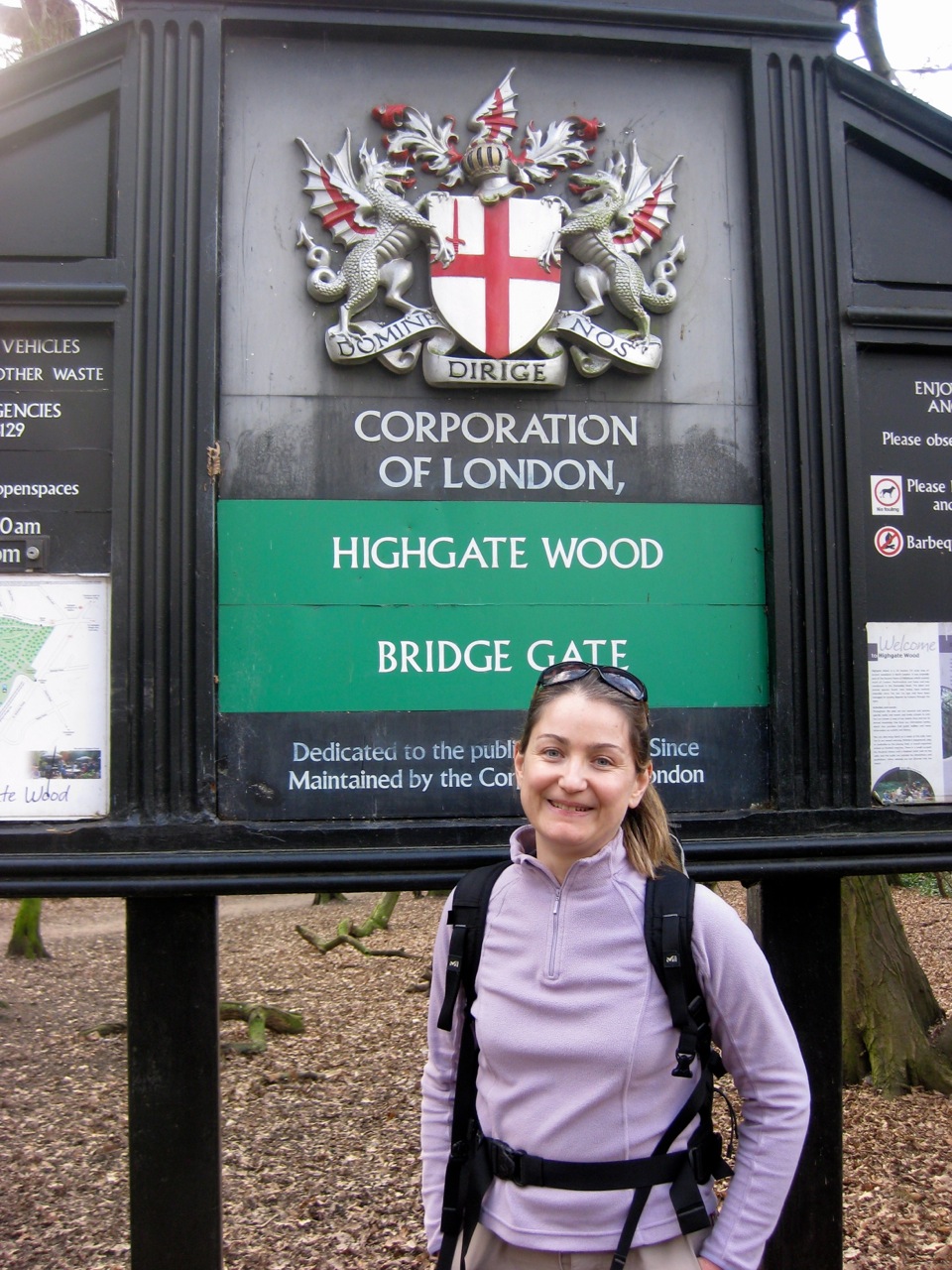
Metal gates at the entrance to Highgate Wood.
The parks are remnants of the ancient Forest of Middlesex. The walking was quite strenuous in parts, and a lot of climbing to get to the official end of this segment of the path, at Highgate underground station. All told, it was 5.5 miles. It took us nearly three hours, including a nice stop for coffee and cake.
Windowshopping in Highgate village.
We finished the afternoon with a leisurely lunch in Highgate village.
Please join us for the next walk, on March 18. We pick up where we left off, at Highgate underground station, at 11 AM.